
Microalgae and sustainable packaging: the future of packaging with the Multiply project
Innovation in the packaging sector is undergoing an unprecedented transformation, driven by the need to find alternative raw materials that are truly sustainable and less dependent on fossil fuels. This cutting-edge scenario includes: European project Multiply, a strategic initiative funded by the programme Horizon Europe, which promises to redefine the standards of the circular bioeconomy.
The aim of the project is extremely ambitious: to develop 10 new products for 5 different application sectors, using the microalgae as a biological alternative to petrochemical or food-grade raw materials. This challenge combines materials science, biotechnology, and industry, aiming to create a low-impact production ecosystem.
Microalgae: A strategic resource for the circular bioeconomy
Microalgae represent one of the most promising frontiers for modern industry. Unlike terrestrial crops, they do not require agricultural land for food production and possess extremely rapid growth, capturing large amounts of CO2 during their development. Thanks to their biochemical versatility, they can be cultivated to produce functional compounds with high added value.
In the context of the Multiply project, research focuses on five specific species, selected for their unique properties:
-
Diatoms: unicellular algae characterized by a silica skeleton, useful for structural applications.
-
Arthrospira (Spirulina): known for its high protein content and functional pigments.
-
Tetraselmis and Nannochloropsis: lipid-rich species, ideal for the production of bio-based oils.
-
Chromochloris zofingiensis: studied for its ability to accumulate carotenoids and complex molecules.
From these biomasses, researchers aim to extract biopolymers and natural additives capable of giving packaging barrier and mechanical properties comparable to those of traditional plastics.
The packaging challenge: from compostable films to barrier coatings
The packaging sector plays a central role within Multiply. Research is aimed not only at creating a biodegradable material, but also at developing technical solutions that solve complex problems in modern logistics. Among the most relevant applications are:
-
High-performance compostable films: flexible packaging capable of degrading naturally without leaving microplastics.
-
Barrier coating for paper substrates: The goal is to create protective layers derived from algae that make the paper resistant to grease and water. This would eliminate traditional paper/polyethylene laminations, making the final packaging much easier to recycle in the paper recycling circuit.
-
Bio-based solutions for flexible packaging: The use of algal oils for the synthesis of new polymers allows for a reduction in the carbon footprint of plastic packaging production.
Active packaging and new features for the market
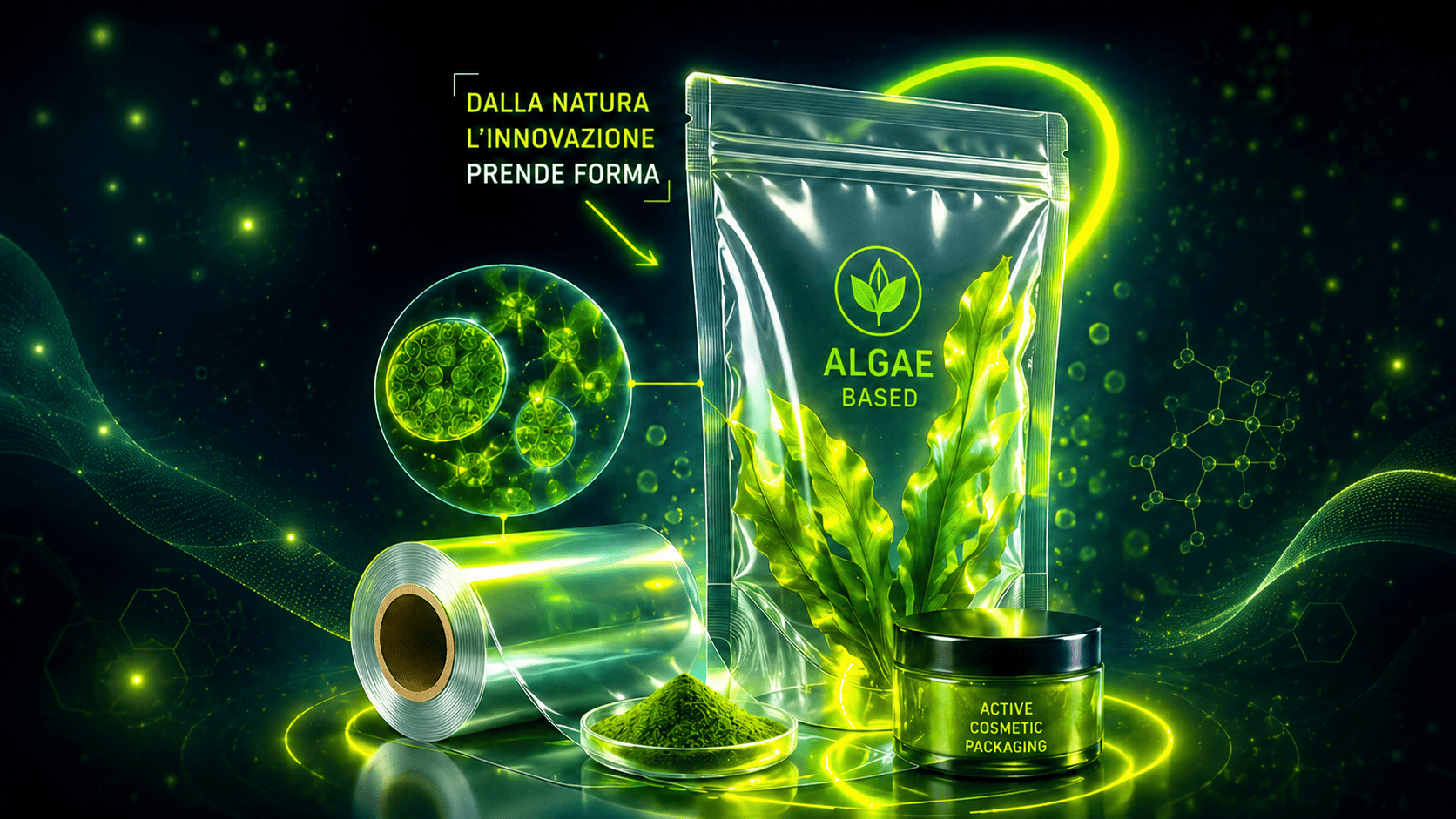
A revolutionary aspect of Multiply concerns the concept of active packaging, especially applied to the cosmetics sector. In this case, the packaging ceases to be a simple passive container. Thanks to the integration of algal extracts and encapsulation matrices, the packaging interacts positively with the contents, ensuring greater stability of the active ingredients and prolonging the shelf life. shelf life of the product. This approach reduces the need for added chemical preservatives in formulations, offering the end consumer a more natural and safe product.
Innovation, Research, and Sustainability: the future of flexible packaging
The packaging sector is undergoing a profound and irreversible transformation. Microalgae, biomaterials, and innovative coatings are just some of the technologies that could radically change the way we design and consume packaging in the coming years. However, technology alone is not enough: an industrial vision is needed to translate research into solutions applicable on a large scale, while maintaining the production efficiency required by the global market.
For companies like Teamplast Srl, closely following these evolutions means not only remaining competitive, but actively driving the change towards a more responsible business model. The ideal participation in this flow of innovation involves planning that prioritizes simplification of structures. While on the one hand European research such as the Multiply project opens the doors to new bio-based polymers, on the other hand the flexible packaging industry has already identified in monomateriality the key to effective recycling.