
Plastic food packaging: what does "suitable for food contact" really mean?
In common parlance we often hear about “food grade plastic”. From a technical point of view, however, the correct question is more precise:
Is that material and packaging compliant for the contact conditions expected with that specific food?
Food contact suitability is not a generic quality that can be attributed to any bag simply because it is made of polyethylene.
It is the result of legislative requirements, choice of raw materials, conditions of use, good manufacturing practices, documentation and conformity checks.
The European regulatory framework
The Regulation (EC) No. 1935/2004 establishes the general principle: under normal or foreseeable conditions of use, materials in contact with food must not transfer components in quantities such as to:
- endanger health;
- unacceptably modify the composition of the food;
- deteriorate its organoleptic characteristics.
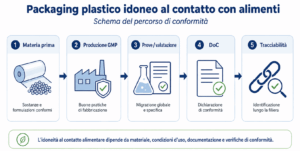
For plastic materials and objects, the Regulation (EU) No. 10/2011, with the list of authorised substances, restrictions, migration limits and rules for demonstrating compliance.
Global migration and specific migration
The concept of migration it is central.
Global migration
Overall migration considers the overall amount of constituents that can be transferred from the material to the food simulant.
Specific migration
Specific migration, on the other hand, concerns certain substances for which individual limits are foreseen.
Tests and evaluations must be consistent with actual or foreseeable use:
- type of food;
- contact time;
- temperature;
- surface area/volume ratio;
- other conditions of use.
These variables can change the compliance framework. Therefore, a correct declaration must also describe any limitations on use.
The declaration of conformity is not a label
In the marketing stages other than retail, the Regulation (EU) No. 10/2011 provides for a written declaration of conformity for plastic materials and objects and for intermediate products.
The document must clearly identify the material to which it refers and be supported by supporting documentation.
This is an important point for those who buy packaging:
Asking for a statement does not mean collecting a standard sheet of paper.
It means ensuring that the product, raw materials, conditions of use and documentation are consistent.
Traceability and GMP
The Regulation (EC) No. 1935/2004 requires the traceability of materials and objects throughout the production and distribution phases.
The Regulation (EC) No. 2023/2006 discipline instead good manufacturing practices (GMP), requiring documented quality assurance and control systems.
For printed packaging, GMPs also address the risk of substance transfer from the printed surface to the food contact side, through the substrate or by set-off.
What should the customer communicate to the manufacturer?
To properly design a food packaging It is useful to know at least:
- food or family of foods;
- contact time;
- temperature;
- any heat treatments;
- filling mode;
- storage;
- end use.
This information allows you to check whether the proposed solution is consistent with the intended use.
The Teamplast approach
In food packaging, quality isn't limited to the finished bag: it includes raw materials, process, hygiene, traceability, document control, and application knowledge.
For this reason, the technical comparison between the customer and the processor is an essential part of the project.
Saying that packaging is "food-safe" is simple. Demonstrating why it's suitable for its intended use is the work behind that definition.
Do you have a food app? Together, we define the conditions of use and documentation requirements, evaluating the application's characteristics and the information needed to identify a solution consistent with the intended use.