
How thick should an LDPE bag be?
Because more microns doesn't always mean more resistance.
When talking about LDPE bags and flexible packaging, one of the most frequent requests is apparently simple:
“Can we increase the thickness of the bag to make it more resistant?”
The intuitive answer would be yes, but when designing flexible packaging thickness is only one of the parameters at play.
A thicker bag may improve some performance, but it doesn't automatically mean a better bag. The final strength depends on the combination of material, formulation, geometry, manufacturing process, welds, and actual usage conditions.
What does “70 microns” really mean?
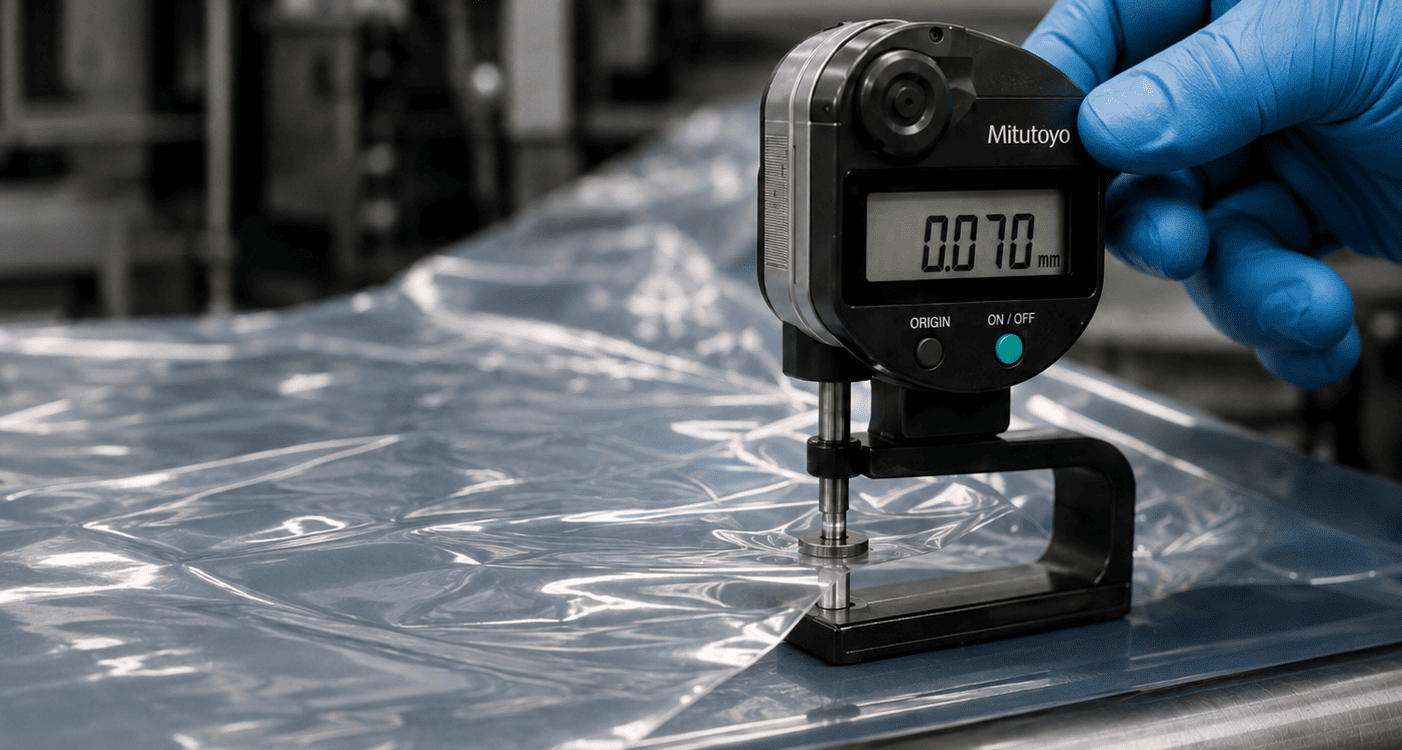
A microns (µm) corresponds to a thousandth of a millimeter. A film from 70 µm therefore has a nominal thickness of 0.070 mm.
On a single envelope the difference between 70 and 100 µm It seems minimal; on millions of pieces, however, it becomes a significant quantity of raw material.
At the same size and density, going from 70 to 100 µm approximately 43% more material is used.
This does not mean, however, that you automatically get the 43% more performance: mechanical properties do not all increase linearly with thickness.
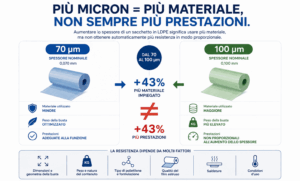
What does resistance really depend on?
Envelope dimensions and geometry
Larger surfaces and different shapes change the stress distribution.
Weight and nature of the contents
Soft, granulated, frozen products, metal components or objects with sharp edges require different performance.
Polyethylene type and formulation
Toughness, elasticity, stiffness and tear resistance also depend on the choice of granules and additives.
Extruded film quality
Homogeneity, thickness tolerances and process stability impact performance consistency.
Welding
In many applications the critical point may be the seal, not the film.
Terms of Use
Temperature, filling, handling, transport and storage must be considered already in the design phase.
Does more microns mean more resistance?
Increasing the thickness may be the right solution when the application requires it.
But designing starting from the number of microns alone easily leads to oversize the packaging.
The useful question is not:
“How much can we increase the thickness?”
but rather:
“What is the minimum thickness that safely guarantees the required function?”
Reducing thickness does not mean reducing quality
The downgauging It is the optimization work with which we try to reduce the weight of the packaging while maintaining the necessary performance.
It is not a simple thinning: it requires knowledge of the material, testing, process control and verification on the real application.
A purely theoretical example:
- 1,000,000 20g sachets require 20,000 kg of material.
- If the same function could be guaranteed with a solution from 16 g, consumption would drop to 16,000 kg.
- The result would be 4 tons less raw material per year.
The PPWR goes in the same direction
The Regulation (EU) 2025/40 introduces the principle of packaging minimization: weight and volume must be reduced to the minimum necessary while maintaining functionality.
Annex IV links this assessment to concrete criteria, including:
- product protection;
- production and filling processes;
- logistics;
- mechanical resistance;
- hygiene requirements.
The principle, therefore, is not “less plastic at any cost”, but less material where technically possible without compromising the function of the packaging.
The Teamplast approach
To define an envelope we don't just consider microns.
We evaluate application, content, size, filling, handling, material, formulation, welding and customization.
The goal is to use the necessary material: no more than necessary, but not less than what is needed to work safely and continuously.
Therefore, there is no one right thickness for all LDPE bags. There is only one thickness that's right for a specific application.
Tell us about your application:
We can evaluate the material, thickness, and performance requirements together, identifying the solution best suited to the actual conditions of use and the needs of your production process.