
Oversized packaging: how much material do we waste without realizing it?
In flexible packaging, a few grams seem irrelevant. Multiplied by hundreds of thousands or millions of pieces, however, they become tons of raw material, purchasing costs, transformation energy, weight moved and waste to be managed at end of life.
For this reason the oversized packaging It deserves attention: packaging must protect the product and function in the customer's process, but material beyond the necessary level does not automatically create value.
What is oversized packaging?
It is a packaging that, in relation to the required function, uses more material, weight, or volume than necessary.
In flexible film it can derive from:
- a thickness historically maintained “for safety”;
- specifications never reviewed;
- excessive margins on dimensions;
- a project no longer aligned with the materials and processes available today.
Warning: Calling it oversized requires proof.
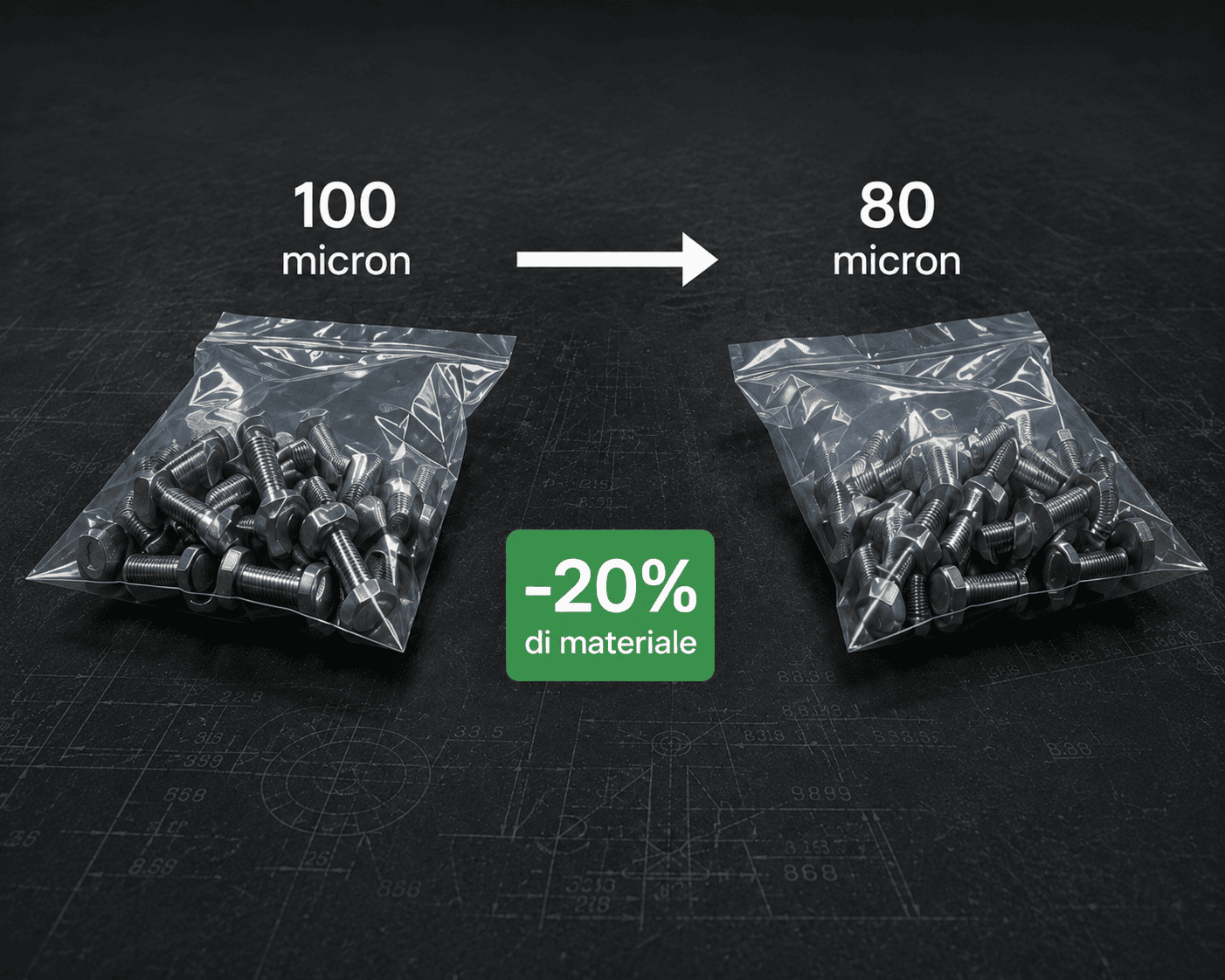
Thicker film may be essential to withstand punctures, loads, temperatures, packaging speeds, or critical seals.
Optimization isn't something you decide on just by looking at microns.
The hidden cost of a few grams
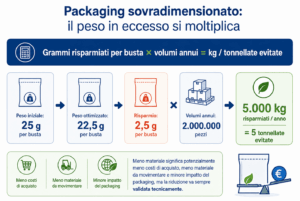
Let's take a reference from 25 g produced in 2 million pieces per year: I am 50,000 kg of material.
If testing and validation allowed us to get down to 22.5 g, a reduction of the 10%, consumption would become 45,000 kg.
The theoretical saving would therefore be 5,000 kg per year.
The economic benefit isn't just the cost of the raw material. Less weight can also mean less material to handle and store and, in some cases, improved logistics efficiency.
The environmental advantage arises above all from the material that does not need to be produced and transformed.
Downgauging: design, not just reduction
The downgauging effective starts from the function.
The performance requirements are identified, the causes of any failures are analyzed, the formulation and geometry are studied, samples are produced and verified on the real process.
An unvalidated reduction can shift the cost elsewhere:
- more packaging waste;
- breakages during transport;
- product loss.
These problems can quickly cancel out the benefit gained on packaging.
The connection with the PPWR
The Regulation (EU) 2025/40 makes minimization a structural principle of design.
Annex IV sets out performance criteria to be considered, including:
- product protection;
- production and filling processes;
- logistics;
- functionality;
- hygiene;
- safety.
This approach is interesting because it overcomes two extremes:
“Let's add a few more microns to be on the safe side” And “We reduce at all costs.”.
The correct way is to document the level of material required for the function.
A practical method of revision
- Measure the actual weight and thickness of the current reference, not just the nominal ones.
- Collect data on breakages, scraps, and problems on the line.
- Define which performances are truly critical.
- Evaluate material, formulation, dimensions and welds.
- Produce an optimized variant and test it under real-world conditions.
- Quantify annual savings only after validation.
The Teamplast approach
Withholding tax reduction is one of the cases in which sustainability and economy can go in the same direction.
But it only works if it is supported by technology.
The goal isn't to sell a thinner envelope: it's to design an envelope that performs the same function using fewer resources when that's actually possible.
Give us a reference: We can discuss weight, performance, and optimization options together, evaluating where material can be reduced without compromising functionality, safety, and process continuity.