


Paper or plastic? The material that seems more sustainable isn't always the one that pollutes less.
“Paper or plastic?” It seems like a simple question.
It is also one of the most frequently asked questions when talking about packaging sustainability. The problem is that, formulated like this, it does not have a scientifically valid answer for all applications.
A material is not sustainable or unsustainable at all.
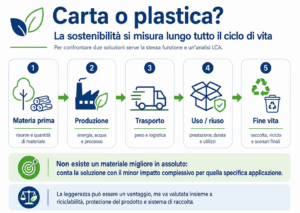
To compare two solutions, you must first verify that they perform the same function and then observe the entire life cycle:
- raw materials;
- quantity used;
- production;
- transport;
- use;
- reuse;
- recycling;
- end of life.
The starting point: same function
Comparing a paper bag and a plastic one only by kilogram of material can be misleading if very different weights are needed to achieve the same performance.
The so-called functional unit It is essential: the comparison must concern solutions that protect or transport the same quantity of product under the same conditions.
This is why slogans like:
“Material X is always better than material Y”
they are of little use in industrial design.
What is Life Cycle Assessment?
The Life Cycle Assessment, or LCA, is a method for assessing the environmental impacts associated with the different phases of the life cycle of a product or system.
It is therefore not limited to the moment in which we see the packaging, but tries to consider what happens before and after.
For packaging, the relevant variables may include:
- consumption of raw materials;
- energy and water;
- packaging mass;
- transport;
- number of uses;
- product protection;
- collection;
- recycling;
- other end-of-life scenarios.
Because lightness matters
One of the strengths of flexible packaging is the relationship between function and quantity of material.
A very lightweight solution can require less material per functional unit and reduce the weight moved along logistics.
This does not automatically make plastic the best choice:
- effective recyclability;
- dispersion into the environment;
- recycled content;
- duration;
- collection infrastructure;
remain essential elements.
But it means that weight cannot be ignored in comparison.
When paper can be the right choice
Paper can offer significant advantages in applications compatible with its properties, especially when the collection and recycling system is effective and when complex structures or large quantities of material are not necessary to achieve the required performance.
Even in this case, however, it is necessary to look at the real solution, including:
- any coverings;
- couplings;
- barriers;
- overall weight.
When a single plastic material can be competitive
In applications where packaging is required:
- light;
- moisture resistant;
- weldable;
- with good mechanical performance;
a monomaterial polyethylene film can offer a very efficient function/weight ratio.
If designed to be recyclable in available streams and properly collected, it can represent a rational solution.
The key point is to avoid ideological opposition:
Sustainability is not measured by the sensation a material transmits to the touch, but by the impacts of the system as a whole.
And the product contained?
Packaging that reduces its impact but increases product losses can worsen the overall balance.
Content protection is therefore part of the packaging sustainability, not a separate topic.
This principle is particularly important for foods and products with high environmental or economic value.
The best question
Instead of asking:
“Paper or plastic?”
we should ask ourselves:
Which solution, for this application and in this collection and use system, achieves the required performance with the least overall impact?
It's a less immediate question, but much more useful.
And this is also the reason why Teamplast wants to talk about sustainability through data, design, monomaterials and source reduction, avoiding absolute slogans.
We evaluate the packaging starting from the function and the data, not just from the perception of the material: We can analyze the application, required performance, and solution features together to identify a more informed approach that is consistent with its life cycle.