
From granule to bag: how flexible polyethylene packaging is actually created
A polyethylene bag may seem like a simple product. In reality, before reaching the customer, it goes through a series of technical decisions and processes where a few details can significantly impact the final result.
Follow the path from granule to bag It helps to understand why size, material, printing and welding are not independent elements, but parts of the same project.
1. Start with the application, not the machine
Before the granule comes the question:
What does this packaging have to do?
Contain, protect, separate, cover, be filled automatically, resist cold, be printed, open easily or withstand edges and handling?
The answers determine:
- format;
- thickness;
- type of polyethylene;
- formulation;
- subsequent processes.
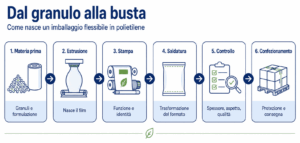
2. Raw materials and formulation
Polyethylene is not a unique material.
LDPE, MDPE and HDPE They have different characteristics and, within each family, the choice of granules and additives allows for the modulation of properties such as:
- elasticity;
- rigidity;
- smoothness;
- weldability;
- mechanical behavior.
A correct formulation must be consistent with both the end use and the production process.
3. Extrusion: the film is born
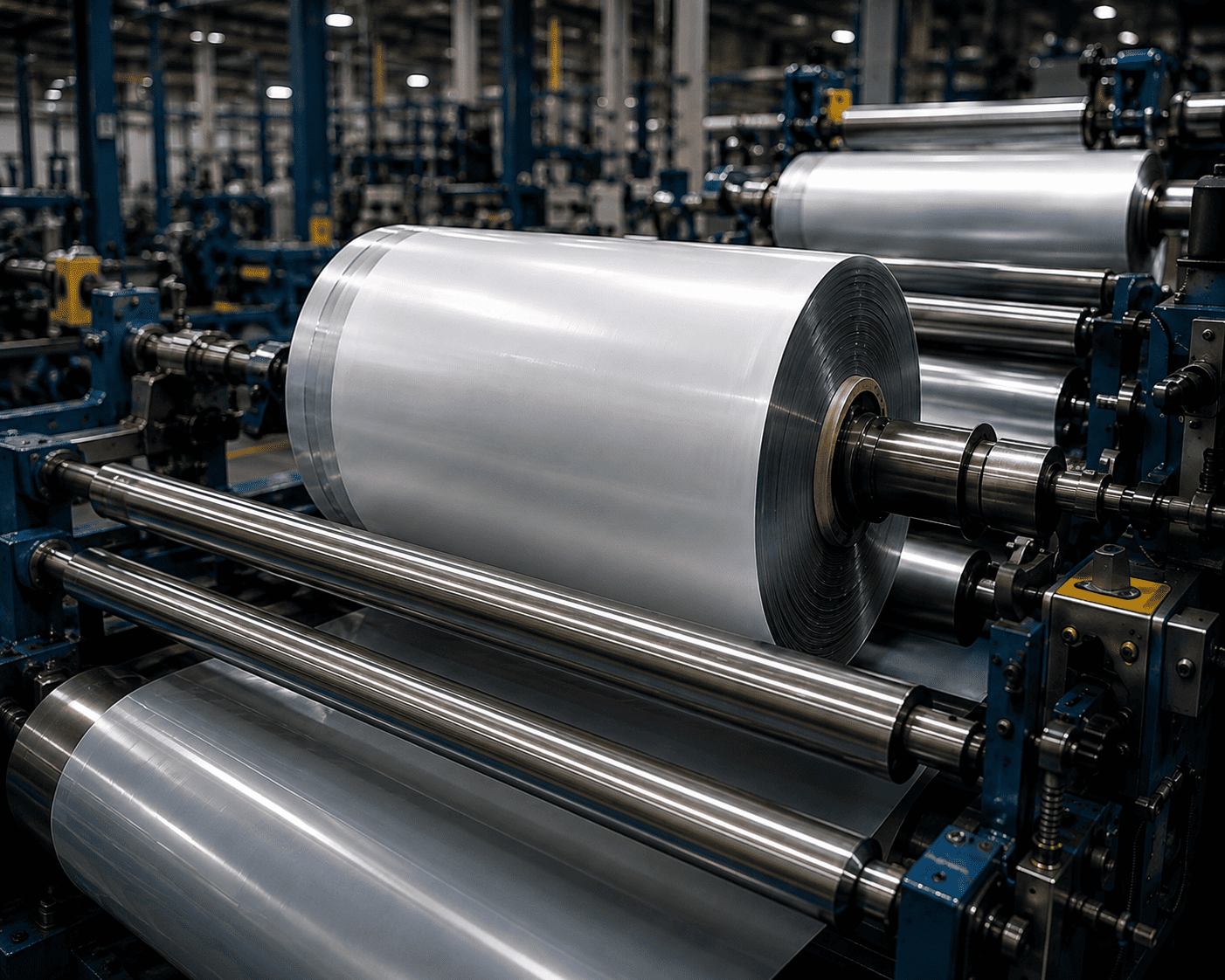
In the'’extrusion the material is plasticized and transformed into film.
In the blown process, the polyethylene tube is formed, cooled and stabilized, then wound into a coil.
This is where key features are built:
- length;
- thickness;
- uniformity;
- surface quality.
Monitoring process stability is essential because a seemingly small variation can have repercussions on subsequent processes.
4. Print: function and identity
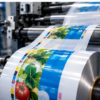
When expected, the flexographic printing transforms the film into a tool of communication as well as protection.
Colors, texts, trademarks, symbols, and technical information must be reproduced with appropriate consistency, register, and adhesion.
For food applications, print management must also be consistent with the good manufacturing practices and with the material configuration, avoiding unwanted transfers to the contact side.
5. Welding and transformation
The reel is then transformed into the final format.
Bottom, side or other welding configurations vary depending on the product.
Parameters of:
- temperature;
- pressure;
- time;
- weld geometry;
must be compatible with film, thickness and application.
It is often at this stage that a technically sound film becomes – or fails to become – a reliable envelope.
6. Customizations and controls
Holes, micro-holes, pre-cuts, handles, closures and other features can be integrated depending on the application.
Checks accompany the process:
- dimensions;
- thickness;
- I wait;
- press;
- welding;
- amount;
- traceability.
All these elements must remain consistent with the agreed specifications.
7. Packaging and delivery
Secondary packaging and palletization also have a technical function:
protect the product during storage and transport and make it practical to use on the customer's line.
Why tell the process
Knowing how an envelope is made also helps you design better.
A requested downstream change can have upstream consequences; a critical welding issue can be formulation- or film-related; a printing requirement can impact the overall design.
The Teamplast approach
At Teamplast, the value lies not only in transforming polyethylene, but in connecting these phases in a process consistent with the customer's application.
Behind a seemingly simple envelope lies a chain of technical choices that must function as a single system.
Want to see how your packaging is created? Contact us to learn more about the process and evaluate the solution best suited to your application's characteristics.