

Extrusion and LDPE monomaterial: the future of flexible and sustainable packaging
In the flexible packaging sector, extrusion technology is the heart of the production process. It is at this stage that the raw material is transformed into a logistical and protective solution. However, today's market demands a quantum leap: it's no longer enough for packaging to be technically high-performance; it must be intrinsically sustainable.
In this scenario, the solutions monomaterial in LDPE (Low-density polyethylene) has established itself as the new benchmark. Designing packaging using a single polymer allows for production efficiency, product protection, and, above all, true and simplified recyclability.
The LDPE extrusion process: precision and technology
Extrusion is a continuous thermomechanical process that transforms polymer granules into a thin, resistant plastic film, used for the production of industrial reels, bags, and pouches. To achieve an excellent product, the process must be monitored with extreme precision at every stage.
1. Controlled power supply and fusion
The LDPE granules are fed into a hopper and conveyed into the extruder. Here, a worm screw pushes the material through temperature-controlled zones. During this stage, the polymer is:
-
Heated up to the optimum melting point.
-
Plasticized to eliminate any discontinuity.
-
Made homogeneous, ensuring that the mechanical properties are constant across the entire surface of the future film.
2. The passage through the die: the heart of the monomaterial
The molten polymer is forced through a circular die. In the case of Teamplast solutions, the use of dies specifically designed for the single material ensures that the film maintains a uniform atomic structure. The quality of the die determines critical variables such as:
-
The constancy of the thickness (micro-framing).
-
There resistence to traction and drilling.
-
THE'’uniformity optics and structure of the material.
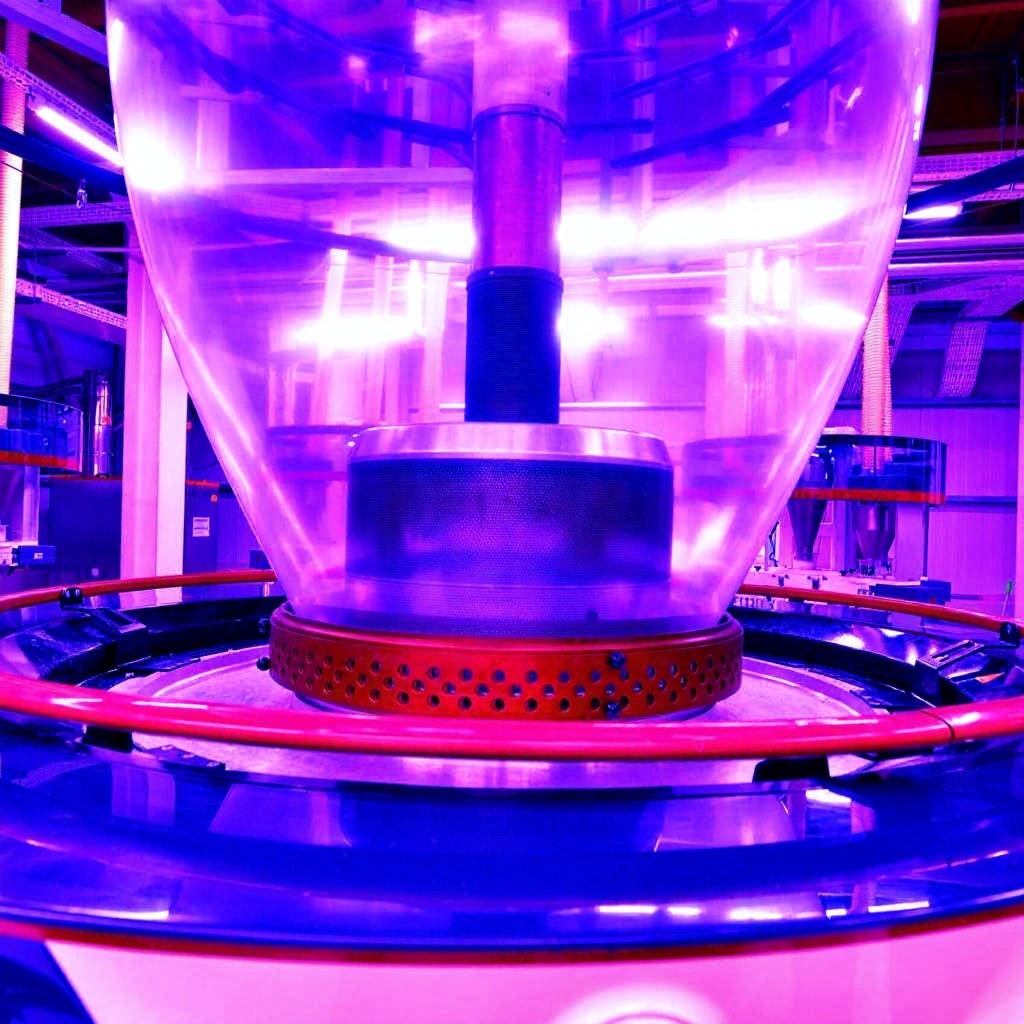
3. “Blown Film” technology (bubble extrusion)
At the exit of the die, the blown air expands the material, creating a "bubble" that develops vertically. This phase is technically defined as biaxial orientation: the material is stretched both longitudinally and transversally. This process:
-
Stabilizes the molecular structure of LDPE.
-
Defines the elastic and barrier properties.
-
It allows the film to cool gradually before being wound onto reels.
Why monomaterial represents the real ecological breakthrough
For decades, the packaging industry has made extensive use of structures multilayer, combining different polymers (such as PE, PET, and PP) to combine their properties. Although effective in protection, these materials have an insurmountable limitation: the difficulty of recycling.
Multilayered materials are complex, if not impossible, to separate mechanically. Consequently, much of this packaging ends up in waste-to-energy plants or landfills, disrupting the circular economy.
The technical and environmental advantages of monomaterial LDPE
Switching to an all-LDPE structure offers advantages that positively impact the entire supply chain:
-
Total and simplified recyclability: A film composed of a single polymer is easily identified by optical scanners in sorting plants. It can be ground and regenerated into new granules without undergoing degradation due to contamination from other materials.
-
Recovery of secondary raw materials: The single-material allows production waste to be reintroduced directly into the production cycle, reducing dependence on virgin polymer derived from fossil sources.
-
Logistics simplification: Managing a single material reduces the complexity of laboratory testing and ensures greater predictability of packaging behavior during the sealing and automatic packaging phases.
Uncompromising performance: the challenge won by Teamplast
A myth that needs to be dispelled is that single-material solutions perform less well than laminated solutions. Thanks to technological innovation in extrusion lines, it's now possible to produce LDPE films with excellent characteristics:
-
Superior mechanical resistance: Ideal for heavy industrial packaging.
-
High weldability: Essential for ensuring the airtightness of bags on high-speed packaging lines.
-
Transparency and brilliance: To enhance the aesthetics of the contained product.
-
Workability: Film flows smoothly through automatic machines, reducing downtime and waste.
Conclusion: designing tomorrow's recycling today
For Teamplast, the extrusion phase is not just a physical transformation of the material, but the practical act through which the company's environmental responsibility is realized. Choosing a single material means adopting the principles of Design for Recycling: design packaging by considering the moment when it will cease to be useful and will have to return to being a resource.
In a global market where ESG criteria have become fundamental evaluation parameters, offer solutions in monomaterial LDPE means actively supporting our customers in achieving their sustainability goals, without ever sacrificing the protection and quality that the industrial sector requires.