

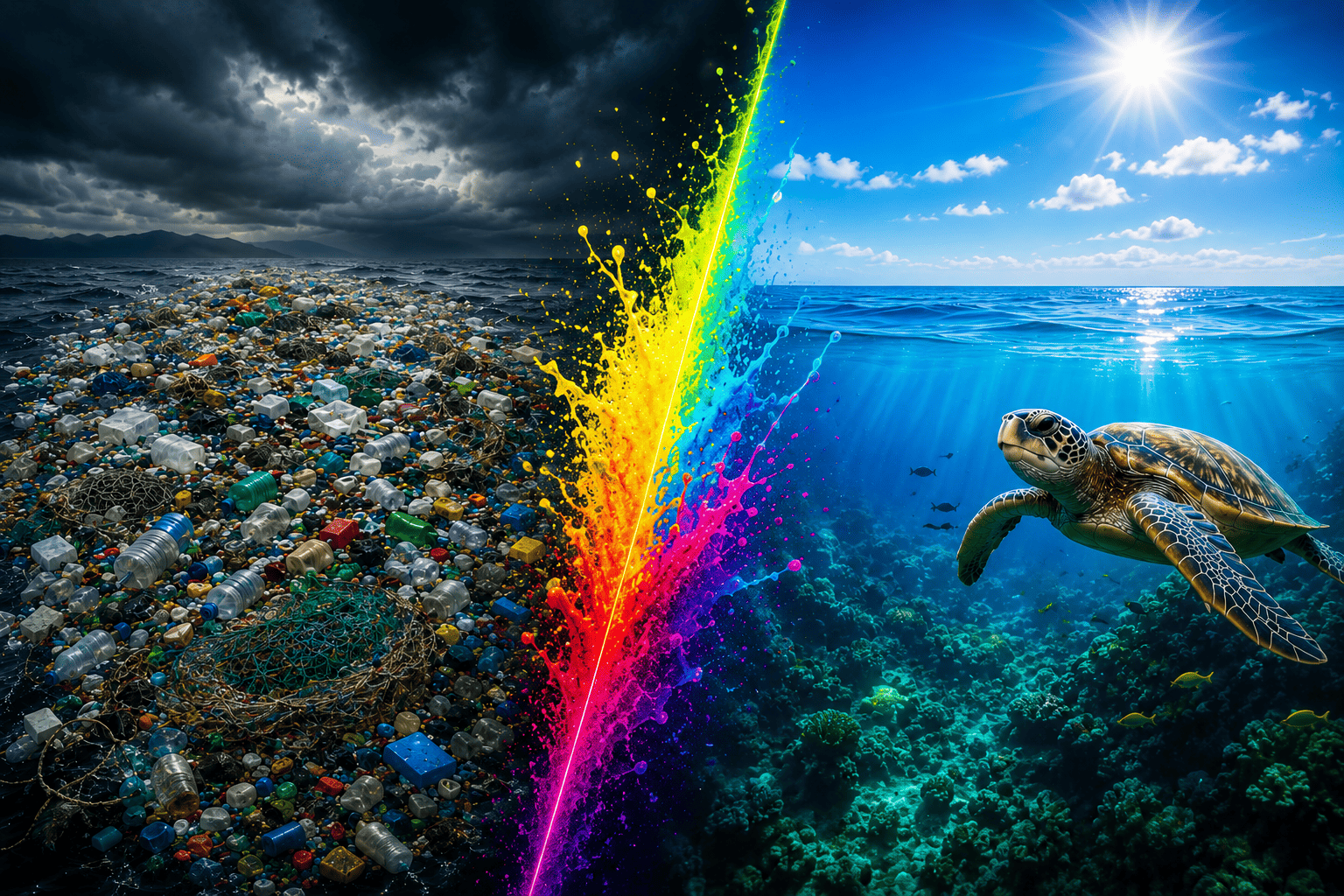
For years, spectacular images and sensational headlines have been talking about the “large floating island of plastic” dispersed in the oceans, often described as a compact mass of waste the size of a nation.
But what does science really say?
The answer is very different from what is often portrayed. The problem of marine pollution exists, but the image of a solid patch of plastic is a simplified media representation, often far from scientific reality.
There is no real “island” of floating plastic
Several scientific studies and international researchers confirm that there is no solid, compact floating plastic platform visible from above or traversable like an artificial island.
What is commonly called Great Pacific Garbage Patch it is actually a vast ocean area where marine currents concentrate dispersed floating materials, mainly microplastics and low-density debris.
In many cases, those who cross these areas do not see a “continuous expanse of plastic” at all, but a seemingly normal sea, with variable concentrations of small fragments.
This distinction is also explained by Ocean Generation delves into the myths surrounding plastic pollution. and from FactMyth's analysis of the alleged plastic island in the ocean.
Who was the first to talk about this huge problem in the oceans?
One of the most important names linked to the diffusion of this theme is that of Captain Charles Moore, among the first to publicly report the presence of large concentrations of plastic in the ocean.
Moore, often associated with the discovery of the “zone” that fueled the myth of the plastic island, talks about it in his book Plastic Ocean: How a Sea Captain's Chance Discovery Launched a Determined Quest to Save the Oceans.
And here's what he says in his book:
“Let's say right away that what we found was not a mountain of garbage, a garbage island, a garbage raft, or a garbage vortex—all media-created exaggerations of the truth. It would later become known as the Great Pacific Plastic Patch, a term that proved very useful but, once again, suggests something different from what's actually out there. It was and is a thin plastic soup, a soup lightly seasoned with plastic flakes, enriched here and there with "dumplings": buoys, clumps of nets, floats, crates, and other macro-debris.“
This distinction is fundamental: the problem is no less real, but it is different from how it is often portrayed.
The work of the Plastics Research Council: bringing the debate back to the science
One of the groups that is contributing most to bringing the topic back to a scientific basis is the Plastic Research Council, a non-profit organization composed of scientists and researchers engaged in the technical analysis of environmental data related to plastics.
According to analyses published by the group, much of the information disseminated over the years has been amplified or communicated inaccurately, creating a distorted perception of the problem.
The Plastic Research Council underlines a very important point: most of the floating plastic mass identified in the ocean areas does not derive from single-use household packaging, but mainly from lost or abandoned fishing gear.
Fishing nets and ghost nets: the real documented problem
One of the most interesting aspects that emerged from the research concerns the composition of ocean waste.
A study published in Scientific Reports, “Evidence that the Great Pacific Garbage Patch is rapidly accumulating plastic”, and reported by the Plastic Research Council, highlights that between 75% and 86% of the large floating plastic mass in the Pacific is made up of fishing nets, ropes and dispersed marine equipment.
The so-called ghost nets, or “ghost nets”, represent a real problem because they continue to trap marine life even after they have been abandoned.
Also Wired, in the article “Fishing Gear Is the Biggest Ocean Plastic Polluter”, highlights the weight of lost fishing gear in the problem of marine plastic pollution.
So the real problem is not the plastic itself, but human behavior and the communication that is built around the theme.
Failure to cut tangled or damaged fishing nets and leave them scattered in the oceans, or discarding unusable items from ships or fishing vessels, should be recognized as irresponsible behavior. Correct, targeted, and data-driven communication could help better understand the problem.
But this is often not done. The real issue is not addressed. The preference is to construct a false image of a mountain of plastic waste floating in the sea, and the viewer believes it without delving deeper, ending up generically accusing the material and its derivatives.
Plastic is not the enemy: the problem is mismanagement and human behavior.
Confusing material with human behavior is one of the most common errors in public debate.
Plastic is one of the most efficient materials ever developed in terms of:
- lightness;
- product protection;
- waste reduction;
- food preservation;
- logistics efficiency;
- reducing emissions from transport.
Numerous studies of Life Cycle Assessment demonstrate that indiscriminately replacing plastic with other materials can increase energy consumption, CO₂ emissions, and the amount of waste produced.
This means, in many cases, making the situation worse.
Even the Plastic Research Council, in the in-depth study “What Science Says About Plastics and the Environment”, underlines the importance of evaluating materials throughout their entire life cycle, avoiding substitutions based solely on perception.
The value of single-material packaging
And this is where the single-material packaging plays a fundamental role.
The packaging in LDPE and HDPE monomaterial in fact they allow you to:
- facilitate waste sorting;
- improve recyclability;
- reduce the complexity of structures;
- optimize the recovery of plastic materials;
- maintain high technical performance.
Real sustainability comes through intelligent design, efficient collection, and the circular economy, not simplistic slogans.
Well-designed, recyclable packaging that's consistent with recycling chains can represent a concrete solution. Not because "plastic must be protected" regardless, but because each material must be assessed based on its real impact, its function, and its end-of-life management.
Teamplast and the culture of responsible packaging
Teamplast Srl strongly believes in this vision: plastic packaging should not automatically be considered a problem, but a resource to be designed and managed correctly.
For this reason the company develops flexible solutions in LDPE and HDPE monomaterial oriented towards:
- production efficiency;
- product protection;
- logistics optimization;
- recoverability of the material;
- technical quality and durability.
In a market often dominated by superficial communication and poorly contextualized information, it's crucial to return to the topic of scientific data, innovation, and real responsibility.
Because the future of packaging doesn't depend on demonizing materials, but on the ability to use them correctly, intelligently, and sustainably.
And those who work in the sector have a specific responsibility: to help spread accurate information, based on real scientific data and a more comprehensive view of the problem.
Plastic shouldn't be talked about with slogans. It needs to be better designed, better managed, and better communicated.